

Podia is an easy-to-use platform for selling digital products, courses, and memberships. It offers customizable storefronts, seamless payment processing, and tools for creating websites and landing pages, making it ideal for creators looking to monetize their content.
- Podia’s intuitive interface makes it easy to set up and manage your online store or courses without technical skills.
- Podia doesn’t charge extra fees on your sales, unlike some other platforms.
- Offers responsive customer support to assist with any issues.
- Podia does not have a mobile app for managing courses or content on the go.
Price: $33/month
I’ve always wanted to offer my digital products and courses online, but I had no idea where to begin until I came across Podia.
I couldn’t help but give this all-in-one platform a try, as it claims to make it simple to create, promote, and sell anything from downloads to courses.
Considering the fact that I had no technology expertise to brag about, I jumped right in, excited to see if technology could turn my thoughts into reality.
I’ll discuss what I found in this Podia Review, what attracted me, and if Podia is worth a try in this review. Hint: it has changed the game in a number of ways!

Developers often question if Podia is suitable for creating engaging web courses or membership platforms.
Podia Overview: What You Can Do With Podia?
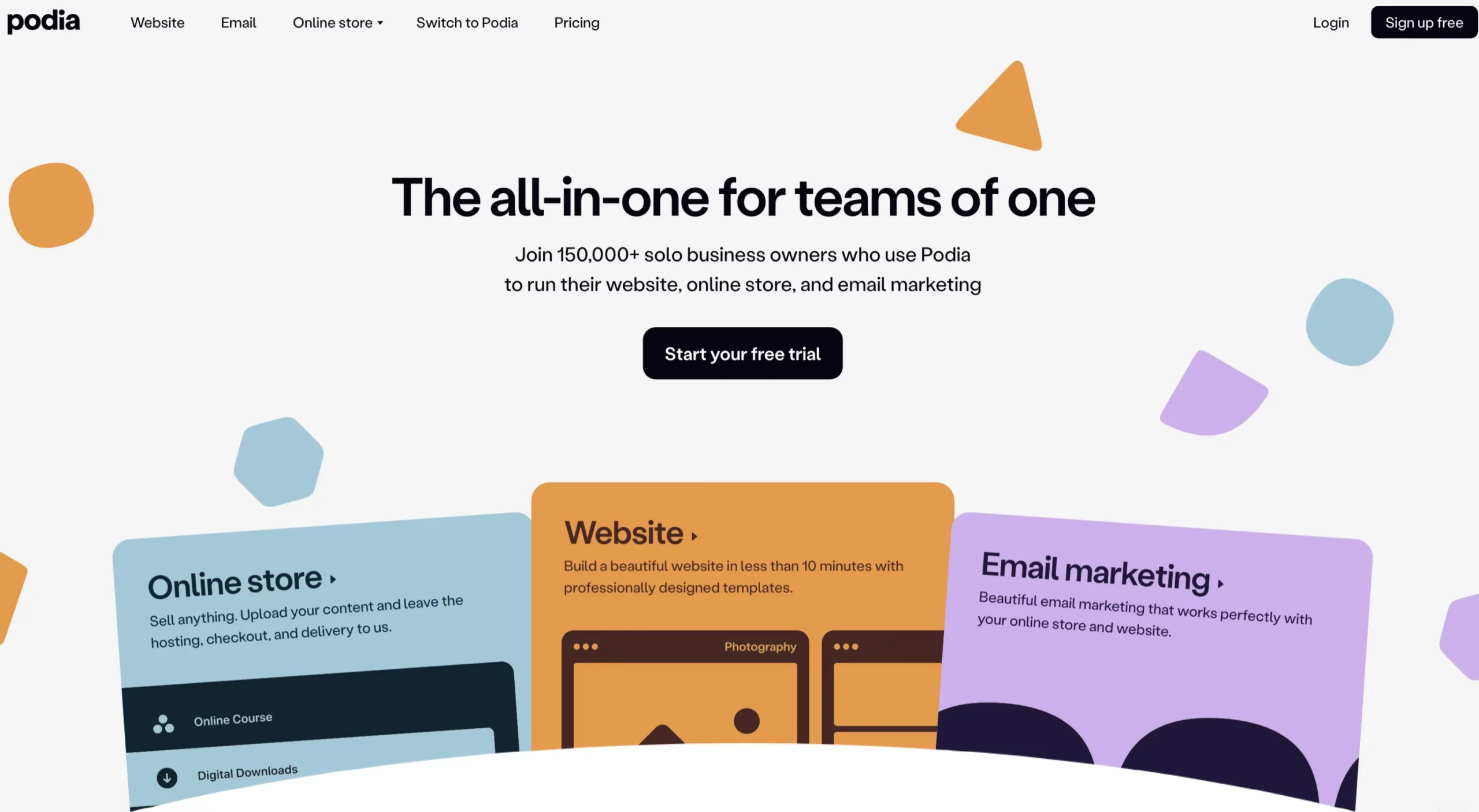
Podia is an online learning platform that hosts and sells online courses, subscriptions, and digital download content. There are no technical issues, processing costs, or unrestricted access to anything.
You will offer your customers online classes, memberships, webinars, and digital copies. It’s the simplest way for digital artists to make a decent living doing what they do.
You can create a stunning storefront in just a few seconds and eventually sell digital items. There is no need for technological information or any third-party extensions.
With one platform, you can manage anything from content creation to delivering customer messages and safely processing transactions. Compared to where it was a few years ago, Podia is a much better website today.
Here’s a quick rundown of the Podia app’s features:
- Create an interesting online membership or program.
- Podia provides unlimited video hosting.
- Using the built-in course player, you can professionally offer your course material.
- Make an appealing sales site for your products.
- You can demand a one-time cost, a monthly membership, or a payment plan.
- Allow transactions quickly and easily with PayPal or Stripe.
- Tackle digital VAT taxes in the EU.
- Build and maintain an affiliate link for your company.
- Send email promotions that are either broadcast or programmed.
Podia’s Key Features
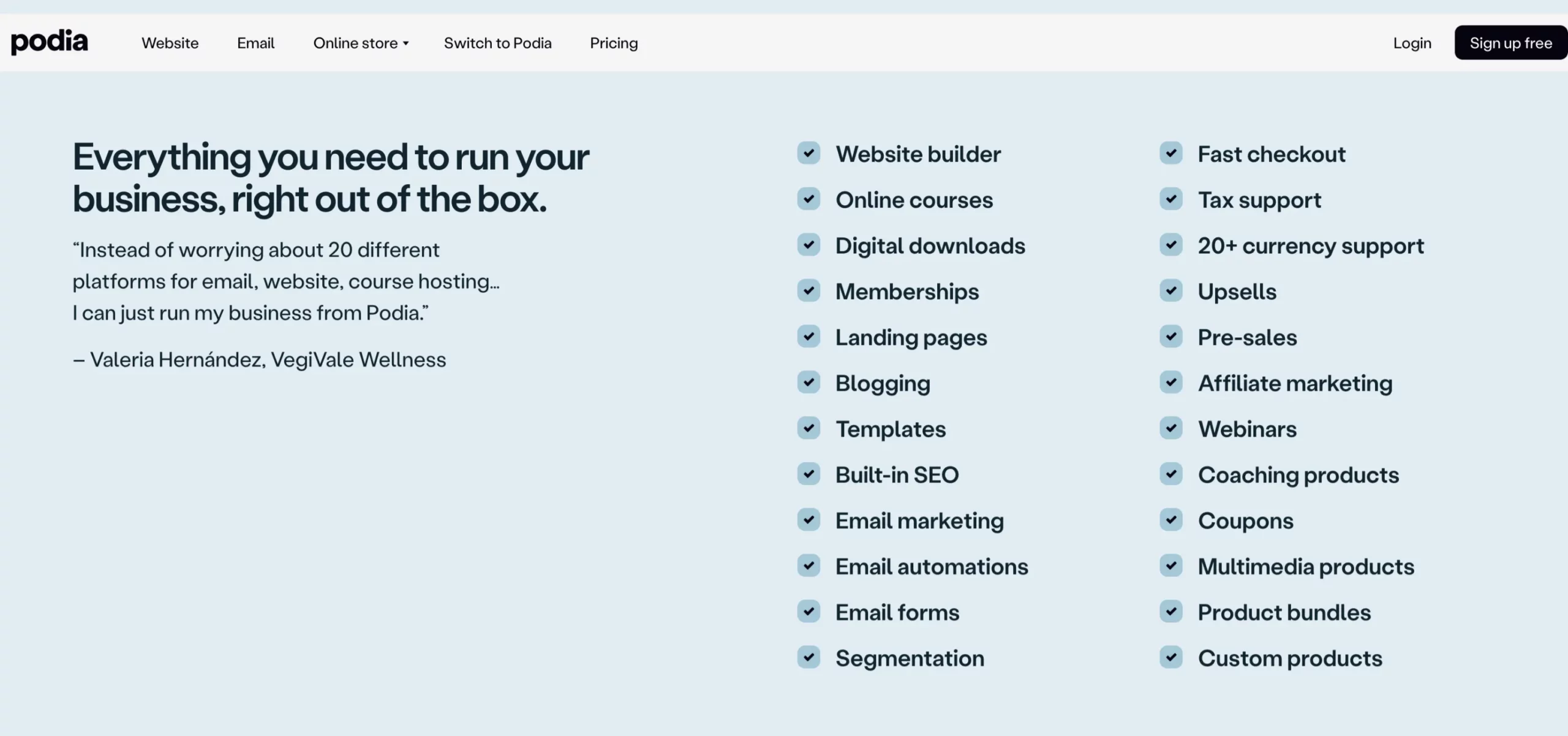
1. Podia Course Area
Additionally, the icons for your next and last sessions are beneath your material, making navigation easier for your learners.
Suppose you have enabled the comments section for your program. In that case, the comments section will be located at the end, allowing your learners to engage, interact, ask questions, and give feedback without leaving the course player, which is exactly what you want.
Another feature I appreciate about the Podia course player is that your learners can cover the entire navigation toolbar by clicking the small button at the top of the screen. The content area takes up the entire window, which is perfect for a distraction-free studying experience.
2. Sales & Marketing Features
Podia provides all the resources you need to manage transactions and offers marketing and sales courses.
Since Podia is not an all-in-one strategy, it may not have a sales funnel builder or a full-fledged email campaign remedy. With all that insight, let us take a closer look at what the website has to deliver.
3. Email Marketing Tools
Podia provides a few simple lead-generation resources to begin with. You may obtain email addresses by adding a previously launched registration form to your product pages or a newsletter registration form to your marketplace.
Podia allows you to submit both one-time and automatic messages for email campaigns. As a result, you can deliver an automated email campaign to your program buyers and those who sign up for the program waiting list.
You can develop some messages, set a timetable for everything to be sent, and determine the mechanism for when the emails should be sent out utilizing their campaign creator. For your project, you may also set entrance and exit criteria.
You may, for instance, sign anyone up for the project when they fill out one of the previously launched email forms and then delete them until they purchase one of the items.
4. Membership Website Builder
Podia has a product form, “Membership, ” which allows developers to create unique “Posts” for your users and combine your courses.
Such “Posts” run in the membership region independently and are perfect for offering one-off information that does not follow a regular pattern, such as online courses.
Additionally, you can plan your updates, submit an email update, and more, making this a handy function for a member site creator.
A significant aspect of Membership Posts is how to open and utilize them as a company name blog. Remember that it’s more of a hack than a proper blogging resource.
5. Learning & Engagement Tools
Course designers employ a range of educational resources to involve students and assist them in achieving the change expected.
Questionnaires, program enforcement, certificates, and other common training and interaction resources are just a few examples. Let us begin with Podia’s educational resources.
It helps you soak up your learning content, for starters. You may set up a timetable for your course segments and generate emails that instantly notify your learners when fresh stuff is ready.
Podia has a useful dripping function that allows you to access dripped course materials for potential learners. You can offer your students instant access to various lessons or even the full course.
Quizzes are yet another common tool for learning provided by Podia. As a result, you can build a multiple-choice questionnaire to assess your learners.
- Live Preview: There is really no switching back and forth between your editor, and there is also a separate tab to preview your content.
- Customizable Layouts: All the things out there are fully customizable as here with Podia Editor. You can easily customize every element.
- Fast and Simple: The best part is that here, you don’t have to be a designer or a developer to drag and drop your way to create your simple and stunning pages right with Podia Editor.
6. Site Design & Customization
In this part, we will look at how Podia operates when allowing you to establish a brand on the website.
The key benefit of utilizing a hosted system like Podia would be that you will not have to worry about independently purchasing a hosting service or an SSL certificate or about technical difficulties such as protection, upgrades, or maintenance.
Furthermore, every school created with Podia receives a complimentary subdomain (for example, mysite.podia.com), and you can also use your specific domain name (like mysite.com). Now, look at Podia’s resources for creating and customizing your site.
7. Website Themes
Site themes are always the first thing to consider when developing a website. Podia currently doesn’t offer website designs; all the shops created on the system use the same design by default.
Colors are the only factor you can alter at the website level. You may change the background color and the colors of the titles, words, and keys.
You do have the option of changing the preset fonts for your text box and headers. However, apart from these things, you have no power over your site’s layout or design. You can’t adjust the design of your site’s heading or other features, such as the navigation bar or keys.
Furthermore, if you are a power user, you cannot reach your site’s database or attach CSS code to change the design. The good news is that the standard design is simple and sleek, so your shop and sales pages will look really good.
8. Checkout Process
The payment method at Podia is a multiple-step procedure but excellently optimized. Your customers don’t need to build a profile to make the purchase; they have to insert a little information to complete the sale.
There is no actual payment page. Instead, the whole process takes place in a window. The advantage of this transaction is that your customer can finish the transaction without quitting the page.
You can also use this store experience on other sites independent of your Podia domain. As a result, you can include a purchase key, a product card, or a textual link on your main page, and your users can finish the entire purchase process without exiting it.
Another feature of Podia’s purchase process that I like is that it lets you generate EU VAT for your programs. If you enable the “Collect EU VAT” feature in the configuration, Podia will automatically update the appropriate VAT amount for your courses.
Finally, you might include a single-click upsell and a coupon on your transaction and checkout page. The best feature is to attach multiple upsells for the exact item.
9. Third-Party Integrations
Because Podia’s built-in online marketing capabilities are so restricted, you will almost certainly need a third-party email service company. Podia partners with some famous email marketing channels, which is excellent news.
ConvertKit, MailChimp, GetResponse, Drip, MailerLite, and ActiveCampaign are natively integrated.
You may send a person’s details to your email service company and connect him or her to a particular list or label and tag them when they participates in one of your programs.
Podia currently includes a Zapier integration. So unless you use some email systems that Podia does not explicitly integrate with, you can still transfer user information through Zapier.
Furthermore, Zapier will connect to thousands of third-party applications, such as ClickFunnels (for funnels and checkout), Quickbooks (for accounting), Accredible (for certificates), and much more.
Lastly, Podia helps you to incorporate third-party scripting into your site, allowing you to use resources like ConvertBox, Deadline Funnel, Facebook Pixel, Google Analytics, and others.
10. Product Pricing & Payment Processing
Podia supports Stripe and PayPal for payment processing so that the students can pay with a credit/debit card or PayPal. Furthermore, the funds are deposited directly into your account (instant payouts).
Regarding pricing choices, Podia’s “Products” and “Memberships” function in various ways. Your “Products” (Courses, Digital Downloads, and Product Bundles) may have a one-time price and a payment schedule.
One issue with pricing “Products” in Podia is that several price points are impossible. As a result, it is not simple to sell the standard version of your course for $99 and the premium version for $199 in Podia.
You can have different plans and select which Products and Posts are available under each plan when you build a “Membership,” but this only works for subscriptions. In addition, you can charge a monthly or annual fee for your membership, and you can even offer a free trial.
Coupons, which allow you to discount your goods by a sum or a percentage, are one useful tool Podia provides for product pricing.
You can generate coupons for all or only a few of your goods. Plus, you can build direct links to your sales page that apply the coupon automatically at checkout, which is fantastic.
Podia The Page Builder:
If you want to customize your Podia storefront and landing pages or sales pages nicely, you will enjoy using the Podia page builder.
The page builder has many pre-built elements that you can add to your page with a single click.
As a result, you can quickly create a product banner, course summary, author profile, FAQs, and testimonials, among other things.
Some common elements can be used to build custom parts for your sales page, such as “Image with Text,” “Video with Text,” “Columns,” and so on.
They also have section themes, which allow you to customize background and text colors at the section level, a handy feature.
Overall, the website builder is extremely simple to use, and even if you have no design or coding experience, you can easily produce a professional-looking sales page.
Podia Website Builder:
Podia’s Online Store feature simplifies selling various digital products, including online courses, ebooks, templates, and tutoring sessions.
The platform handles smooth product delivery to your clients, checkout management, and content hosting. Its major qualities consist of:
- Sales pages that are fully customizable to create a polished, visually appealing shopfront.
- Built-in payment options like Stripe and PayPal support multiple currencies and methods, including Google Pay and Apple Pay.
- Tools to bundle products, apply discounts and handle taxes across 230 global tax jurisdictions.
- Options to build landing pages and websites, plus the ability to add discussion forums to enhance your offerings.
- With Podia, you can effortlessly launch, run, and grow your digital business, free from technical headaches.
Podia Pricing: How Much Does Podia Cost?
Podia offers simple and affordable pricing options. Its pricing is straightforward, and it will get your online business up and running.
The best part is that the Podia platform also offers a 30-day free trial offer that doesn’t require any credit cards.
Switch to yearly billing and save even more with these plans:
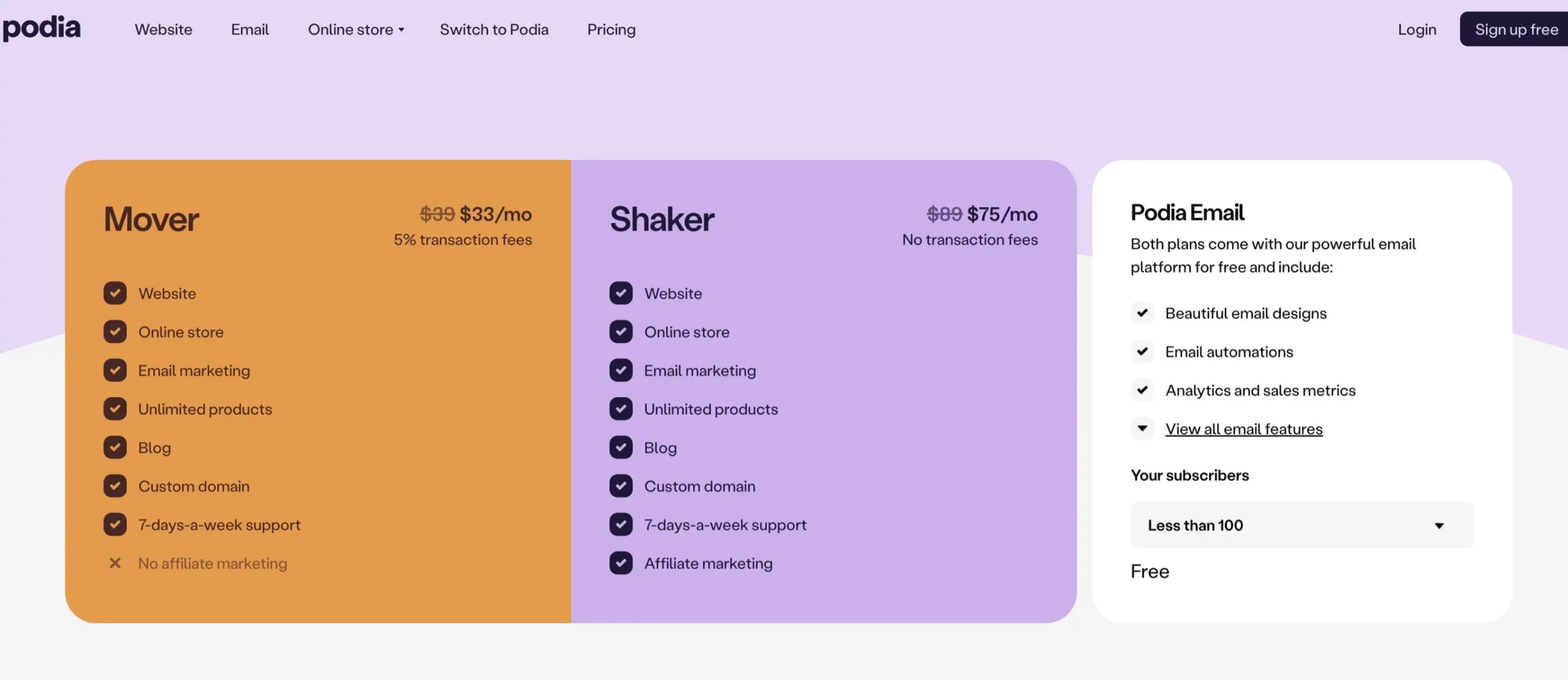
Also, if you select the yearly plans, you will get better monthly rates. Also, check the Podia Discount Coupon.
Podia isn’t cheap, but its features and interface are great and compensate for the price. Podia mainly offers two pricing plans; let’s check out what they actually are:
| Plan | Price (Billed Annually) | Regular Price (Monthly) | Transaction Fees | Key Features |
|---|---|---|---|---|
| Mover | $33/month | $39/month | 5% | Website, online store, email marketing, unlimited products, blog, custom domain, 7-day support |
| Shaker | $75/month | $89/month | 0% | All Mover features + affiliate marketing, Podia Email, no transaction fees |
- Mover Plan: Costs $33/month if you pay yearly (saving $72 compared to $39/month for 12 months). It includes the basics for selling but charges a 5% fee per sale and skips affiliate tools.
- Shaker Plan: Drops to $75/month annually (saving $168 over $89/month for 12 months). It adds affiliate marketing and Podia Email with no transaction fees, which is better for bigger earners.
- Both plans offer unlimited products and 7-day-a-week support.
Podia Email Included
Both plans include access to our email platform at no extra cost, featuring:
- Beautiful email designs
- Email automations
- Analytics and sales metrics
Build your audience and manage your subscribers effortlessly with our powerful tools.
Checkout Process:
To begin selling digital products on Podia, you’ll need to link either your bank account or PayPal to the platform. Podia supports both Stripe and PayPal for handling customer payments.
Keep in mind, though, that PayPal doesn’t work with recurring or subscription-based community plans because of limitations in processing those types of transactions for that, you’ll need to use Stripe.
The upside with Stripe is that it allows your customers to pay smoothly with their credit cards, and you’ll usually see the money in your bank or PayPal account within just 2 days.
Podia Ease of Use
Podia makes creating and selling online courses super simple—it’s the easiest platform I’ve tried.
The layout looks clean and tidy, with everything you need right at the top in a clear menu. Each option—like Products or Settings—explains itself, so you don’t guess what’s what.
Podia uses a step-by-step navigation style. You start with big choices up top, then click deeper into specific stuff. Need to find something? It’s a breeze, and you don’t need days to figure it out. For example, hit the Products menu, and you’ll see just two picks: check your existing stuff or add a new one. Pick “new,” and it asks what type—like a course or download. This smart setup flows everywhere on the platform, and I love how smooth it feels.
Creating a course is just as easy. You upload your videos or files, then arrange them with a drag-and-drop builder—no fuss. Podia even whips up sales and checkout pages that are linked to your product for you, so you skip the hassle of building those yourself.
Overall, Podia’s ease of use stands out big time. I’ve poked around tons of course tools, and this one tops the list for being so user-friendly. It’s a snap to jump in and get going!
Podia Platform Security
We all know that if a website or a checkout page is not secure, nobody will make any transaction.
So it’s better to have a secure checkout page so your customers can easily enter their details and make any purchase.
Stripe and PayPal generally protect your Podia Checkout. The best part is that Podia doesn’t collect any information when a customer goes through the checkout; all the checkout pages and interfaces are entirely secured.
You will be amazed that all your transactions are mainly sent through an encryption process protected by 128-bit SSL encryption.
This will help you if you are trying to sell your online courses or digital downloads, as people often try to game the system to get everything for free.
One plus point of choosing Podia is that they offer free SSL certificates for both pricing plans, which provides extra security to your transactions.
Podia Customer Service
As mentioned above, support matters a lot regarding software or tools in the market.
One drawback of Podia is that they lack the phone support they should provide their customers. Podia offers emails and live chat support.
The Shaker plan will provide migration assistance if you move from a different platform. But that’s not what bounds Podia, as it also has a Blog where everything is updated on time, so you can easily relate to that.
Overall, I would like to say Podia support is about as good as it gets without phone and medium support.
Affiliate Marketing
Podia protects you if you intend to use affiliate marketing to advertise your programs. Using Podia, you could connect affiliates to your shop and generate new affiliate links for each item.
In addition, the affiliates will exclusively use the dashboard to manage their affiliate connections and monitor profits and commissions.
When it refers to partner commissions, you have the option of paying a percentage of the revenue or a flat fee. You can also configure the commission at the handy product stage.
Why Do I Recommend Podia?
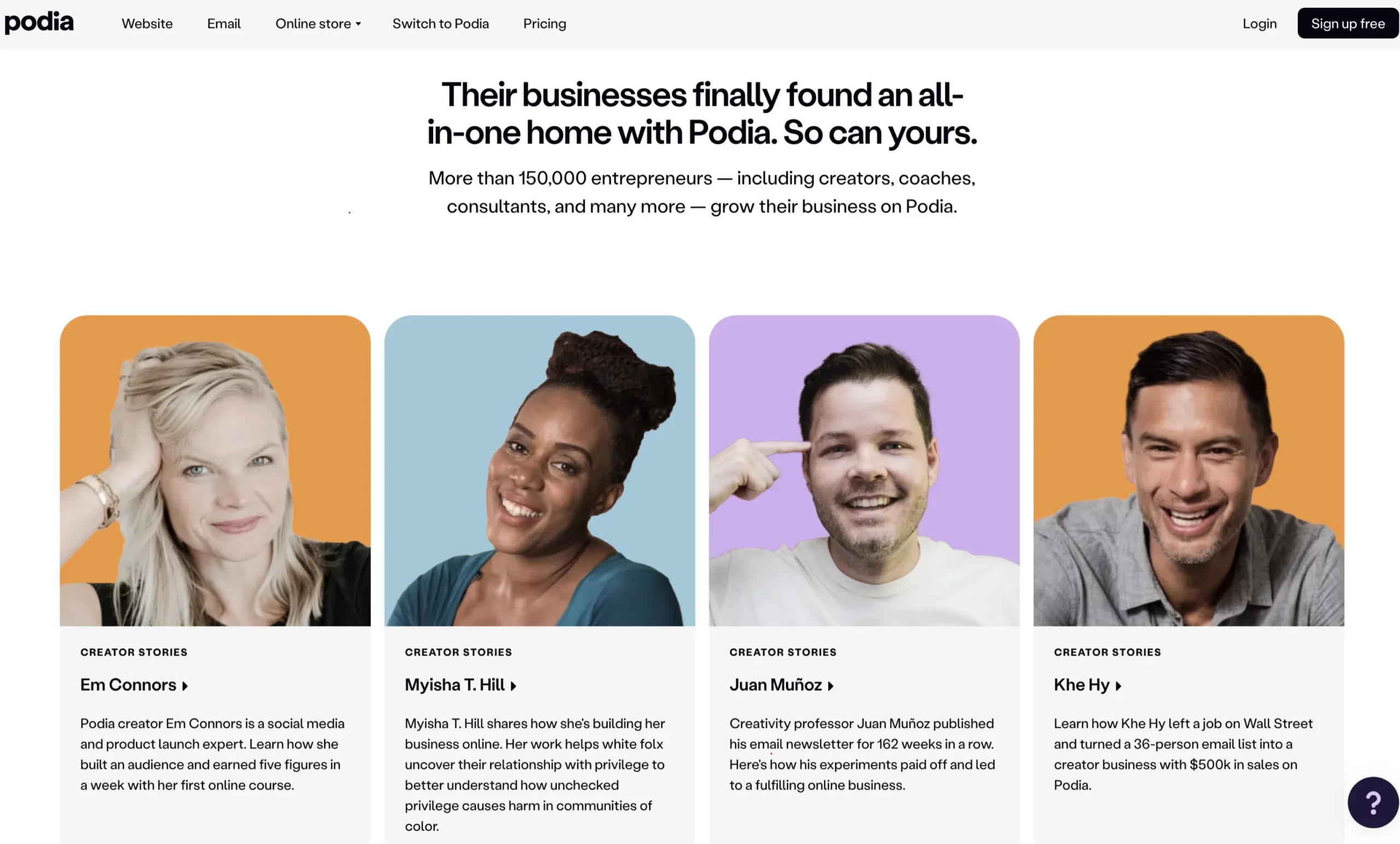
Podia is the most concise way to create and offer courses and subscriptions online.
Even if you have no specialist or coding knowledge, you could host and distribute your content, achieve a good storefront, and begin offering it in a few hours.
By far, it is the smoothest interface UX interaction I have had with an e-learning system, and I have tried a few in the past.
In less than 24 hours, the squad could move me from Failjabi, and the assistance was highly personal and loving. It also offers quality products at affordable prices.
I like the other software I use for specific web pages, and I am a big computer geek. Still, now I realize that while it has many cool features, creating a new course or maybe even a simple gift option is highly tricky.
Podia was the perfect match for my requirements, still has the best interface, and has been the most cost-effective choice for everything I required.
The Podia framework appealed to me because of its simplicity and importance.
When crafting a wealth-building curriculum, I couldn’t see myself investing twice or three times as much as Podia on another forum as I instruct someone else on how to create wealth while being careful with money.
Podia was chosen because it appeared easier to understand and as a side business economic start-up company. Quality is essential to me, and they also addressed all of my queries before I signed up.
Podia Pros & Cons:
Pros
- Setting it up feels super easy, and I got started in no time!
- The storefront and course player look modern and slick right from the start.
- You can create special “Posts” just for subscribers.
- Add checkout or buy buttons to other sites without a hassle.
- Podia handles EU VAT on digital products for you—no stress there.
- Chat with visitors live using the built-in messenger.
- Send autoresponder emails to keep your audience engaged.
- Customer service rocks—they’re quick and helpful.
- No transaction fees hit you on any plan (though your list says otherwise—assuming Shaker Plan here!).
Cons
- The course builder lacks flexibility, and you can’t upload files from cloud storage like Google Drive.
- It skips key learning tools like graded quizzes, assignments, certificates, or compliance features.
- You can’t set up a standalone community space on your site.
- There’s no mobile app to manage things on the go.
- Reporting tools cover the basics but don’t dive deep.
- It won’t work if you want a full-blown website with tons of features.
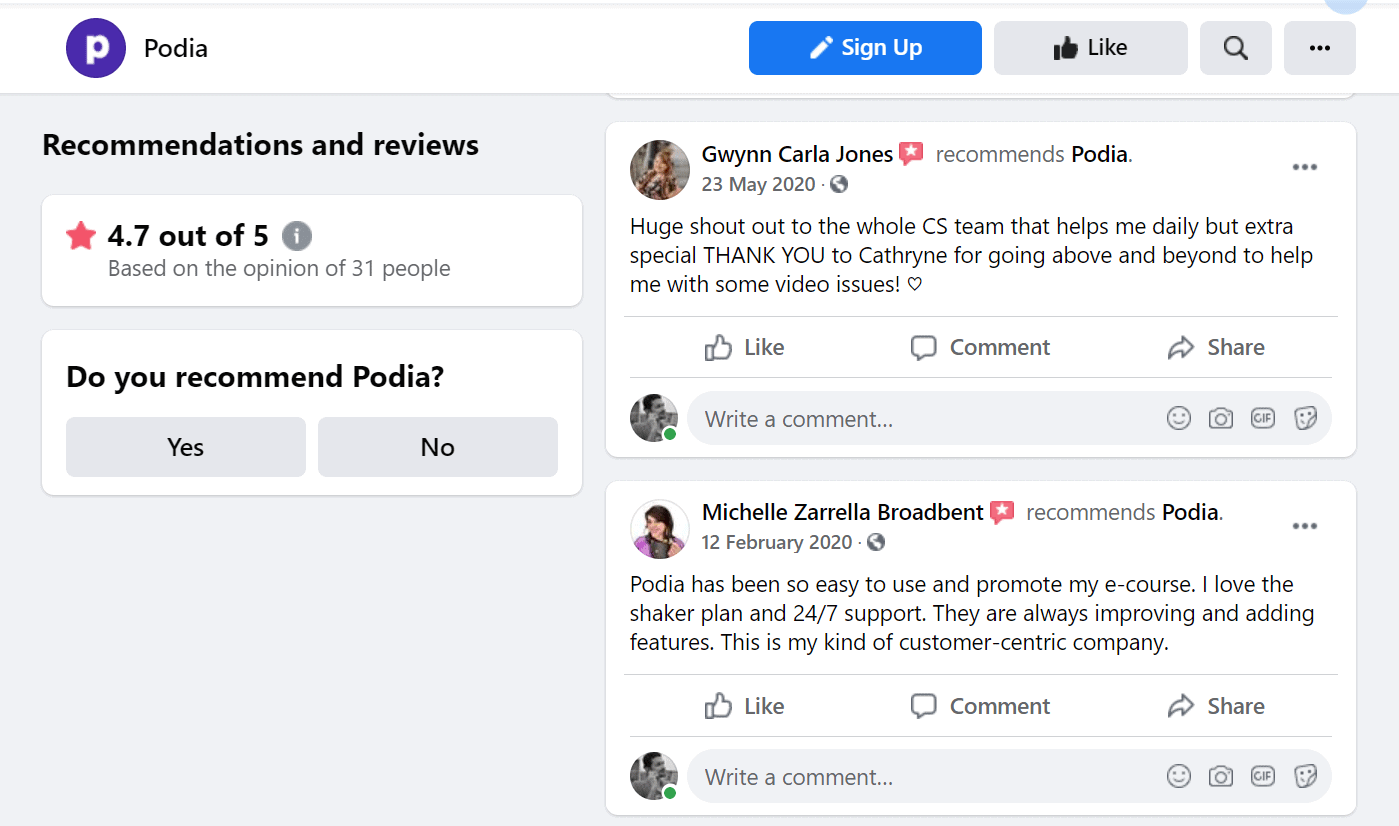
Podia Customer Reviews & Testimonials:
Podia Frequently Asked Questions
📱Is there a mobile app for Podia?
No, Podia doesn’t have a dedicated mobile app, but the platform is mobile-friendly and can be accessed through a browser.
🤳🏻Can I offer quizzes or certificates with Podia?
Currently, Podia allows quizzes as part of course content, but it doesn’t offer built-in certificate features.
🌍Is Podia available globally?
Yes, Podia is available worldwide and supports multiple currencies for selling to international customers.
✂️ What do I get with the free plan?
You get a website, one course, one download, a community, and email broadcasts—all free. It’s limited, though, only draft mode for extra products, and that 10% fee stings.
⏳ How long does it take to set up?
You can get started in minutes! Sign up, pick a plan, and use their drag-and-drop builder to make a site or course. I had a basic page up in under an hour, and no tech skills were needed.
🏆 How’s it stack up to rivals?
Podia’s simpler than Kajabi (less overwhelming) and cheaper than Teachable (no big fees). It skips advanced stuff like quizzes but shines for ease and value.
😬 What if I mess up?
Podia’s undo button and support team have your back. I deleted a page by mistake once—chat fixed it fast. You won’t lose sleep over errors.
📦 Can I bundle products?
You can! Group courses, downloads, or memberships are included in one offer like “Writing Bundle: Course + eBook.” Buyers pay once and get it all.
🤔 Is Podia worth it long-term?
If you’re growing small digital biz, yes, it’s affordable and scales with you. Big creators might outgrow its simplicity, but I’m sticking with it for now!
🚀 How fast can I sell with Podia?
You can start selling in a day! Upload a course or file, set a price, and share the link. Podia handles the rest. I had my first download live in the afternoon.
🌐 Does Podia give me a website?
It does! You get a full storefront with pages for courses, downloads, and a blog. Use your own domain (like yourname.com) or stick with a Podia URL it’s ready to go either way.
Quick Links:
- Learndash Vs Teachable
- The Definitive Guide To Building Online Courses Using WordPress Plugins
- Best Podia Alternatives For Making Money Selling Courses
- Xperiencify Vs Podia
- Spayee vs Podia
- Podia Pricing Plans
Conclusion: Podia Review 2026
You can now access detailed information about Podia’s pricing, features, functionality, pros, cons, and other important details.
You decide what to do next. However, I highly recommend Podia to my readers as a dependable platform for selling online courses, memberships, digital downloads, and more.
I hope this post meets your needs. In the comments, please let us know which platform you use to sell your courses, memberships, and digital downloads.
