
AI chatbots have gone from a novelty to a weekly habit, and the scale still surprises us. Our roundup of AI chatbot statistics starts with the headline number: ChatGPT is now used by 1.2 billion people in a single week, a figure OpenAI shared at DevDay on September 29, 2026.
We have followed these tools since the first consumer boom, and the 2026 picture is much wider than one app. Below we break down user counts, market size, daily habits, what people ask, business adoption, marketing impact, support results and the accuracy problems that still come with the territory. Every table is built for quick skimming.
Table of Contents
AI Chatbot Statistics 2026: Key Takeaways
If you only read one part of this page, make it this list.
- Users: ChatGPT has 1.2 billion weekly users as of September 29, 2026, up from 100 million in November 2023.
- Market: $11.8 billion in 2026, heading for $41.2 billion by 2033.
- Adoption: nearly half of US adults, 49%, use AI chatbots, and 24% open one daily.
- Business: nearly half of surveyed organizations, 47%, are rolling chatbots out company-wide.
- Marketing: AI-referred retail visits generated 83% more revenue per visit and converted 90% better.
- Support: just 7% of customers turned to a company chatbot the last time they needed help.
- Trust: a 2025 news-integrity study flagged a serious flaw in 45% of AI assistant replies to news questions.
- Paid plans: OpenAI had more than 50 million consumer subscribers by February 2026.
The number everyone is talking about: 1.2 billion weekly ChatGPT users. Three years earlier, the same product had 100 million people in a week. That is a twelvefold jump.
AI Chatbot Quick Facts
Here is the cheat sheet. Bookmark it if you just need the headline AI chatbot numbers.
| Fact | 2026 figure |
|---|---|
| Most-used chatbot (weekly) | ChatGPT, 1.2 billion weekly users (Sep 29, 2026) |
| Gemini app users | 1 billion users (Oct 28, 2026) |
| Meta AI monthly users | More than 1 billion (last official count: Oct 29, 2025) |
| Microsoft Copilot monthly users | More than 150 million (last official count: Oct 29, 2025) |
| Global chatbot market, 2026 | $11.8 billion (estimate) |
| Market forecast for 2033 | $41.2 billion (19.6% annual growth) |
| US adults who use AI chatbots | 49% |
| US adults who use them daily | 24% |
| Organizations scaling chatbots | 47% |
| ChatGPT consumer subscribers | More than 50 million (as of Feb 27, 2026) |

ChatGPT User Statistics and Growth
- ChatGPT reached 1.2 billion weekly users on September 29, 2026.
- That is up from 100 million weekly users in November 2023.
- OpenAI also reported more than 50 million consumer subscribers in late February 2026.
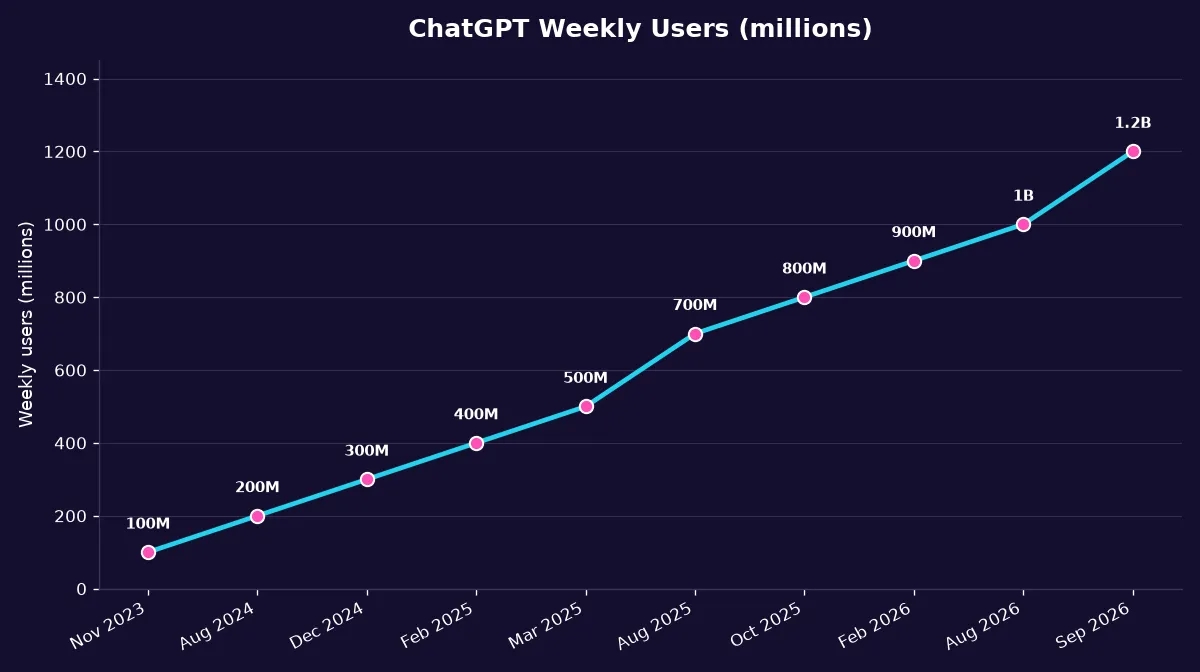
ChatGPT is still the yardstick, and the official counts have climbed in almost every public update. Weekly users went from 100 million in November 2023 to 800 million by October 2025, with stops at 200 million, 300 million, 400 million, 500 million and 700 million along the way.
The 2026 climb was just as fast. OpenAI said ChatGPT had more than 900 million weekly users on February 27, then 1 billion on August 6, and 1.2 billion at DevDay on September 29. In that February update, the company also said it had crossed 50 million consumer subscribers.
| Date | ChatGPT weekly users |
|---|---|
| November 6, 2023 | 100 million |
| August 29, 2024 | More than 200 million |
| December 4, 2024 | 300 million |
| February 20, 2025 | More than 400 million |
| March 31, 2025 | 500 million |
| August 4, 2025 | 700 million |
| October 6, 2025 | 800 million |
| February 27, 2026 | More than 900 million |
| August 6, 2026 | 1 billion |
| September 29, 2026 | 1.2 billion |
Here is OpenAI’s DevDay 2026 keynote, where the 1.2 billion figure was discussed:
Popular AI Chatbots Compared
- Google said the Gemini app reached 1 billion users on October 28, 2026.
- Meta AI had more than 1 billion monthly users as of October 29, 2025.
- Microsoft’s Copilot family had passed 150 million monthly users by that same date.
ChatGPT is not the only assistant with a massive audience, but the labels matter. OpenAI reports people in a week, while Google, Meta and Microsoft usually talk about a month, so those figures should not be ranked as if they were the same thing. On October 28, 2026, Google’s CEO said the Gemini app is now at one billion users, and called it the fastest-growing product in the company’s history. Meta’s last official update, from October 29, 2025, put Meta AI at more than 1 billion monthly users. The same day, Microsoft said its first-party Copilot family had surpassed 150 million monthly users.
| Product | Latest official count | What it measures | Date given |
|---|---|---|---|
| ChatGPT | 1.2 billion | Weekly users | September 29, 2026 |
| Gemini app | 1 billion | Users (Google, Oct 2026) | October 28, 2026 |
| Meta AI | More than 1 billion | Monthly users | October 29, 2025 |
| Microsoft Copilot family | More than 150 million | Monthly users | October 29, 2025 |
Google’s I/O 2026 keynote shows how Gemini is being pushed across Search and the app:
And here is Google’s look at Gemini Omni:
How Big Is the Chatbot Market?
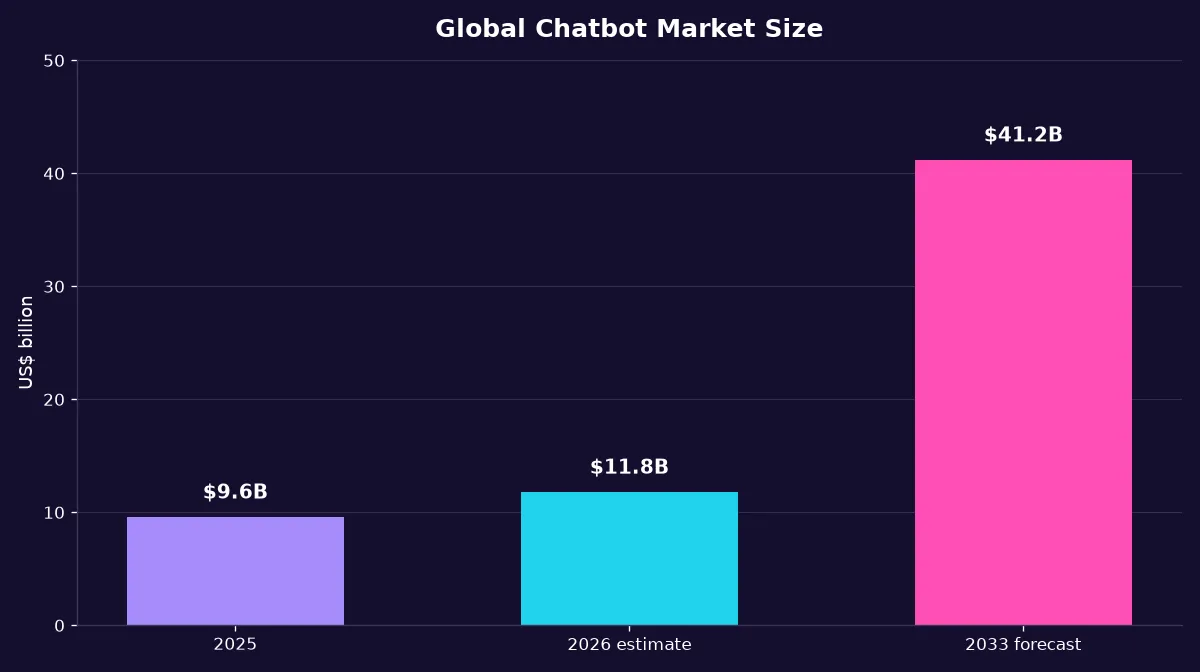
- The global chatbot market is estimated at $11.8 billion in 2026, up from $9.6 billion.
- The same forecast puts the market at $41.2 billion by 2033, a 19.6% annual growth rate.
- North America held 31.3% of the market in 2025, the largest regional share.
User counts grab the headlines, but spending is climbing too. One widely cited estimate puts the global chatbot market at $11.8 billion in 2026, up from $9.6 billion a year earlier. The same outlook has the market reaching $41.2 billion by 2033, or 19.6% growth a year. North America was the largest region in 2025, with 31.3% of worldwide revenue. Other firms publish different totals, so treat any one forecast as a range, not a census.
| Year | Global chatbot market |
|---|---|
| 2025 | $9.6 billion |
| 2026 estimate | $11.8 billion |
| 2033 forecast | $41.2 billion |
| Annual growth, 2026 to 2033 | 19.6% |
| North America share, 2025 | 31.3% |
Daily Chatbot Habits in the US
- Nearly half of US adults, 49%, say they use AI chatbots, up from 33% in 2024.
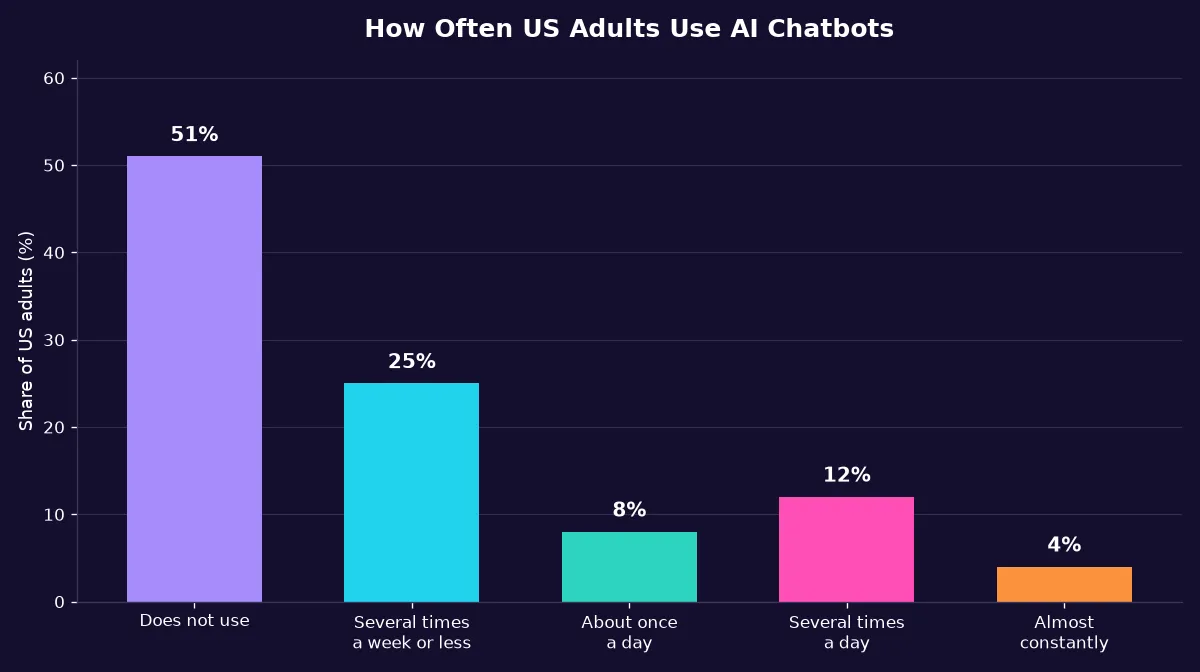
- 24% use one every day, including 12% who do so several times a day.
- 51% still do not use AI chatbots at all.
In the United States, chatbots are now a mainstream habit. A February 2026 survey put US adult use of tools such as ChatGPT, Gemini or Copilot at 49%, up from 33% two years earlier. About one in four adults, 24%, open a chatbot every day: 12% several times a day, 8% about once a day, and 4% almost constantly.
| How often US adults use AI chatbots | Share |
|---|---|
| Do not use AI chatbots | 51% |
| Several times a week or less | 25% |
| About once a day | 8% |
| Several times a day | 12% |
| Almost constantly | 4% |
| Daily, combined | 24% |
The Jobs People Give Chatbots
- 42% of US adults use chatbots to search for information, the top use.
- 38% of employed adults use them for tasks at work.
- Only 4% use a chatbot for companionship.
Search is still the main job. In that same survey, 42% of US adults said they use AI chatbots to look up information, and 38% of employed adults use them for work tasks. A quarter use chatbots for fun, and 24% use them to make or edit images or videos. Medical advice and diet or fitness information each sit at 20%, while news is 13% and companionship is only 4%.
| Use | Share |
|---|---|
| Search for information | 42% of US adults |
| Tasks at work | 38% of employed adults |
| Fun or entertainment | 25% of US adults |
| Create or edit images or videos | 24% of US adults |
| Medical advice | 20% of US adults |
| Diet and fitness information | 20% of US adults |
| News | 13% of US adults |
| Emotional support or advice | 10% of US adults |
| Companionship | 4% of US adults |
Chatbot Use by Age Group
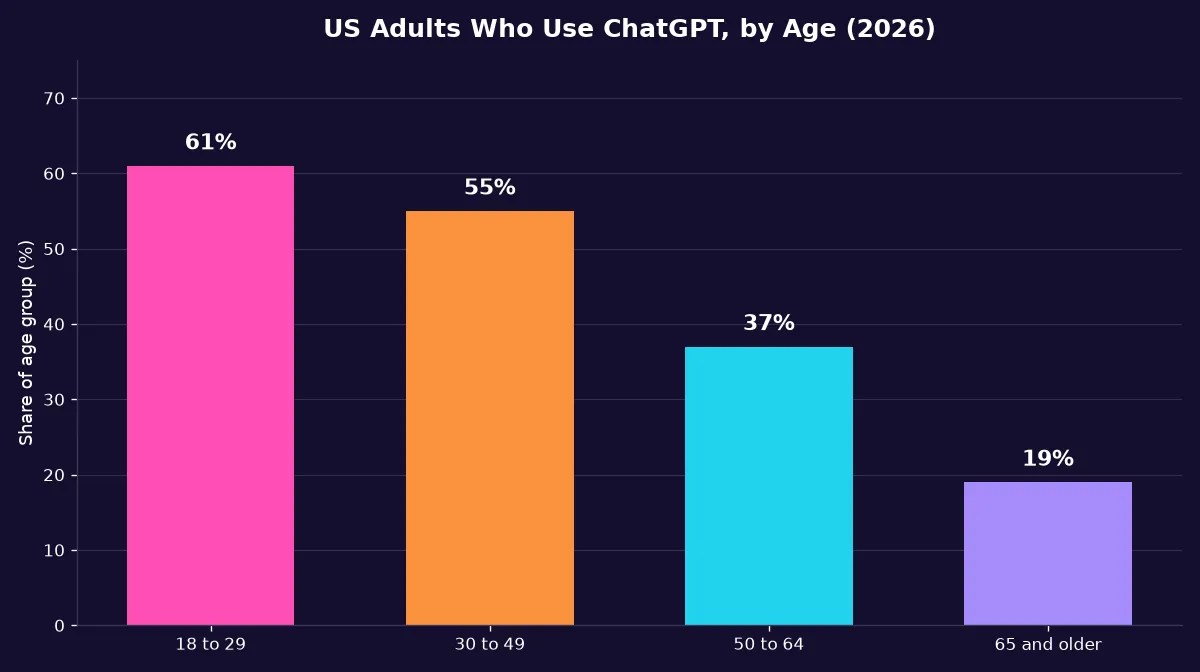
- 61% of US adults aged 18 to 29 use ChatGPT, and 55% of those aged 30 to 49 say the same.
- Use falls to 37% among ages 50 to 64, and 19% among those 65 and older.
- Overall ChatGPT use reached 44% in 2026, up from 18% in 2023.
Younger adults still lead, but the next group has nearly caught up. In 2026, 61% of US adults aged 18 to 29 said they use ChatGPT, and 55% of those aged 30 to 49 said the same. Use falls to 37% among adults 50 to 64 and 19% among those 65 and older. The national ChatGPT figure is 44% in 2026, up from 18% in 2023. English-speaking Asian adults also stand out: 70% use AI chatbots, and 47% use one daily.
| Age group | Share using ChatGPT in 2026 |
|---|---|
| 18 to 29 | 61% |
| 30 to 49 | 55% |
| 50 to 64 | 37% |
| 65 and older | 19% |
| All US adults | 44% |

Enterprise Chatbot Adoption
- 47% of organizations have taken chatbots to company-wide scale, the most widely scaled AI tool in the survey.
- 44% now scale AI across the enterprise, up from 38% a year earlier.
- Among firms with at least $1 billion in revenue, 54% say AI is scaling company-wide.
Inside companies, chatbots are no longer a side experiment. McKinsey’s 2026 global survey found that 47% of organizations have taken chatbots to company-wide scale, the highest share of any AI tool in that comparison. About two in ten said the same about AI agents. Nearly nine in ten respondents reported regular AI use in at least one function, and 44% said AI is now scaling across the company, up from 38%. Large firms still lead: 54% of respondents at organizations with $1 billion or more in revenue reported enterprise-wide scaling, versus 33% at smaller firms.
| Measure | 2026 share |
|---|---|
| Organizations scaling chatbots | 47% |
| Regular AI use in at least one function | Nearly 9 in 10 |
| AI scaling across the enterprise | 44% (up from 38%) |
| AI used in three or more functions | 56% (up from 51%) |
| Large firms ($1B+) scaling AI company-wide | 54% |
| Smaller firms scaling AI company-wide | 33% |
| Large firms scaling AI agents | 40% (up from 27%) |
| Smaller firms scaling AI agents | 22% |

If you are putting assistants inside a sales or support stack, our GoHighLevel review walks through a CRM built around automations. Microsoft’s Build 2026 opening keynote also shows how Copilot is being framed for work:
What AI Chatbot Traffic Is Worth
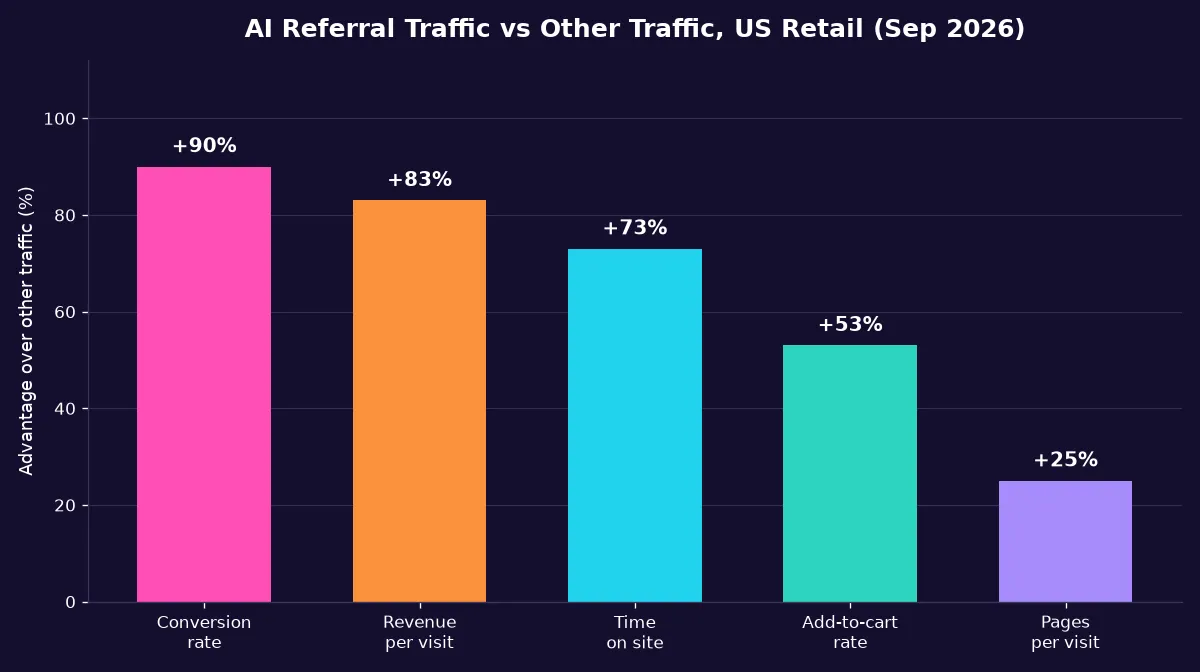
- In September 2026, AI-referred visits generated 83% more revenue per visit for US retailers than other traffic.
- Those visits converted 90% better and spent 73% more time on the site.
- AI traffic to US retail sites grew 71% year over year that month.
This is the statistic that should make marketers sit up. Adobe’s look at more than a trillion visits to US retail sites found that people who arrived by clicking a link in an AI tool generated 83% more revenue per visit in September 2026 than visitors from other channels. A year earlier, those same visits were worth under half as much as a typical session. Those visits also converted 90% better, spent 73% more time on the site and added products to carts at a 53% higher rate. AI traffic itself was up 71% year over year, and Adobe expected even larger holiday jumps. If you want pages that assistants can actually quote, our Copysmith review covers an AI writing tool built for product and marketing copy.
| Metric (Sep 2026, US retail) | AI traffic vs other traffic |
|---|---|
| Conversion rate | 90% higher |
| Revenue per visit | 83% higher |
| Time on site | 73% higher |
| Add-to-cart rate | 53% higher |
| Pages per visit | 25% higher |
| AI traffic growth, year over year | 71% |
Chatbots in Customer Service
- Only 7% of customers used a company chatbot in their most recent service request.
- 49% said they would have used one if the company had offered it.
- After a bad experience, only 27% would try a chatbot again.
The marketing numbers look rosy. The service numbers are more sobering. A Gartner survey of 3,566 customers, fielded in February and March 2026, found that just 7% actually used a brand-owned chatbot the last time they needed help, even though 49% said they would have tried one if it had been available. Customers were about three times more likely to open a third-party AI tool instead, and only 27% would try a chatbot again after a bad experience.
| Customer behavior | Share |
|---|---|
| Used a company chatbot in the latest service request | 7% |
| Would have used one if it had been offered | 49% |
| Would try a chatbot again after a bad experience | 27% |
| Say a human option is essential when companies use AI for service | 87% |
| Likelihood of using a third-party AI tool vs a company bot | About 3 times higher |

Do AI Chatbots Save Companies Money?
They can, when the volume is high and the questions are repetitive. In early 2024, Klarna said its AI assistant handled 2.3 million conversations in its first month and did the work of 700 full-time agents. That is a single company case, not a rule for every help desk. Looking ahead, Gartner predicted in March 2025 that agentic AI will autonomously resolve 80% of common customer service issues by 2029, which would cut operating costs by 30%. That is still a forecast.
Where Chatbot Answers Still Fail
Accuracy is still the weak point, especially when chatbots talk about the news. A 2025 BBC and European Broadcasting Union study flagged a serious problem in 45% of the news answers it reviewed. That is an awkward backdrop for the 13% of US adults who already go to chatbots for news. In customer service, 87% of customers say a path to a person is essential when a company uses generative AI for support.
Key AI Chatbot Records
Here are the standout AI chatbot statistics, in one place.
| Record or forecast | Figure |
|---|---|
| Highest official weekly chatbot audience | 1.2 billion ChatGPT users (Sep 29, 2026) |
| ChatGPT weekly users three years earlier | 100 million (Nov 6, 2023) |
| Gemini app users | 1 billion (Oct 28, 2026) |
| Global chatbot market, 2026 | $11.8 billion (estimate) |
| Global chatbot market, 2033 | $41.2 billion (forecast) |
| US adults using AI chatbots | 49%, including 24% daily |
| Organizations scaling chatbots | 47% |
| AI referral revenue-per-visit advantage | 83% higher (US retail, Sep 2026) |
| News answers with a significant issue | 45% |
| Common service issues resolved by AI, 2029 forecast | 80%, with 30% lower operating costs |
What These AI Chatbot Statistics Mean
The raw counts are striking, but here is what we think they change for publishers, stores and support teams.
Chatbot Answers Are a New Front Door
If 1.2 billion people open ChatGPT in a week, and AI-referred shoppers already spend more when they click through, being easy to quote is no longer a side project.
A Human Handoff Still Closes the Sale
Most customers will give a bot a chance, but only 7% used one last time, and most will not come back after a bad reply. Keep a visible path to a person.
The Spending Wave Has Room to Run
A market heading from $11.8 billion toward $41.2 billion leaves room for tools and niche products. If you want to partner with software companies in that wave, start with our list of the best software affiliate programs.
AI Chatbot Statistics FAQs
How many people use ChatGPT each week in 2026?
OpenAI said ChatGPT had 1.2 billion weekly users on September 29, 2026, at DevDay. That is up from more than 900 million in February 2026 and 1 billion in August 2026.
How big is the AI chatbot market in 2026?
A leading industry estimate puts the global chatbot market at $11.8 billion in 2026, up from $9.6 billion in 2025. The same outlook forecasts $41.2 billion by 2033, a 19.6% annual growth rate.
What percentage of US adults use AI chatbots?
In a February 2026 survey, 49% of US adults said they use AI chatbots, up from 33% in 2024. About 24% use one every day.
Do AI chatbot referrals convert better for retailers?
Yes, in US retail data for September 2026. Visits that came from AI tools converted 90% better than other traffic and generated 83% more revenue per visit.
Do customers prefer company chatbots or human agents?
Most still want a person within reach. Only 7% used a company chatbot in their latest service request, and 87% say a human option is essential when a company uses AI for support.
Are AI chatbot answers accurate enough for news?
Not reliably. A 2025 BBC and European Broadcasting Union study flagged a serious problem in 45% of the news answers it reviewed.
Final Thoughts
These AI chatbot statistics all point the same way: the tools are now mainstream, the market is still growing, and more high-value visitors are arriving from chat windows, not only from search boxes. The open question is trust. Weekly users can keep rising while company bots stay unused, if answers stay sloppy or the path to a person is hidden. We will be watching the next official user counts and whether that 83% revenue gap holds after the holidays.
