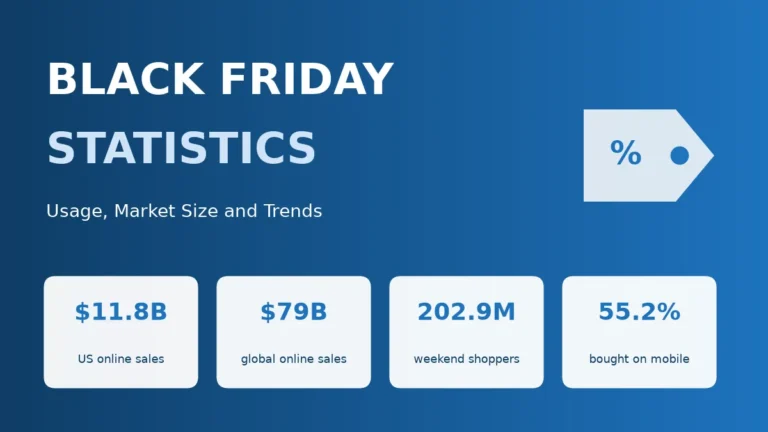

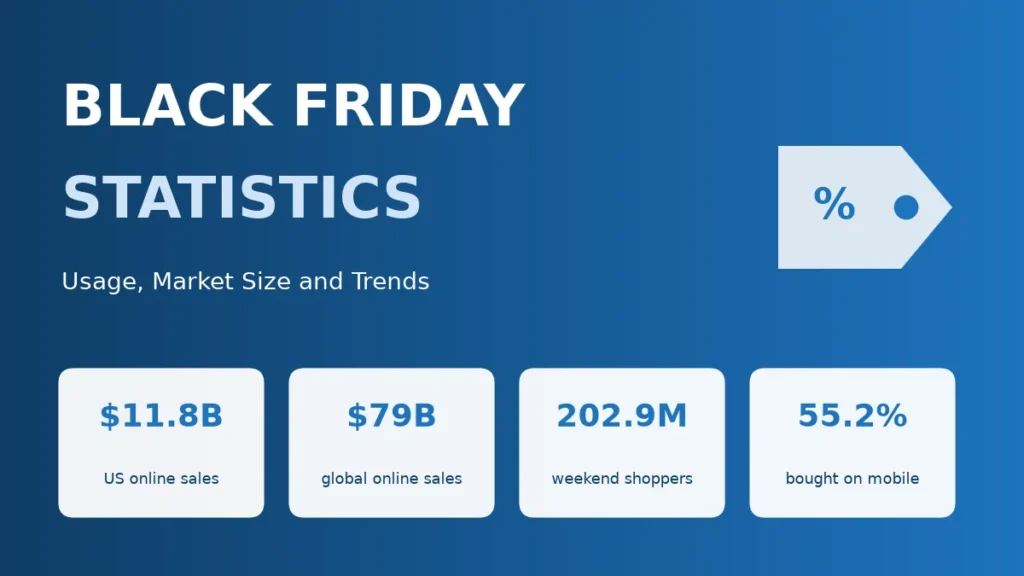
Black Friday statistics for 2026 start with a record. US shoppers spent $11.8 billion online on Black Friday last year, up 9.1%.
The day is now global. Shoppers around the world spent $79 billion online, and 202.9 million Americans shopped over the long weekend.
This page covers sales, shoppers, Cyber Monday, mobile, spending, categories, discounts, payments, AI, countries and what comes next.
Black Friday Statistics 2026: Key Highlights
- US shoppers spent a record $11.8 billion online on Black Friday last year, up 9.1%.
- Global online Black Friday sales reached $79 billion, up 6%.
- A record 202.9 million Americans shopped from Thanksgiving to Cyber Monday.
- Cyber Week online sales in the US hit $44.2 billion, with Cyber Monday the top day at $14.25 billion.
- Mobile devices drove 55.2% of Black Friday online sales, or $6.5 billion.
- Traffic to US retail sites from AI tools jumped 805% on Black Friday.
- Online Black Friday sales are expected to reach $12.9 billion in the US this year.
How much do shoppers spend on Black Friday in 2026?
US shoppers spent a record $11.8 billion online on Black Friday last year, up 9.1% from $10.8 billion.
That is the fourth record in a row. At the busiest hours, shoppers spent $12.5 million every minute. These Black Friday statistics show online sales growing by $1 billion in each of the past two years. Store owners getting ready for the rush can compare platforms in our Shopify ecommerce platform review.
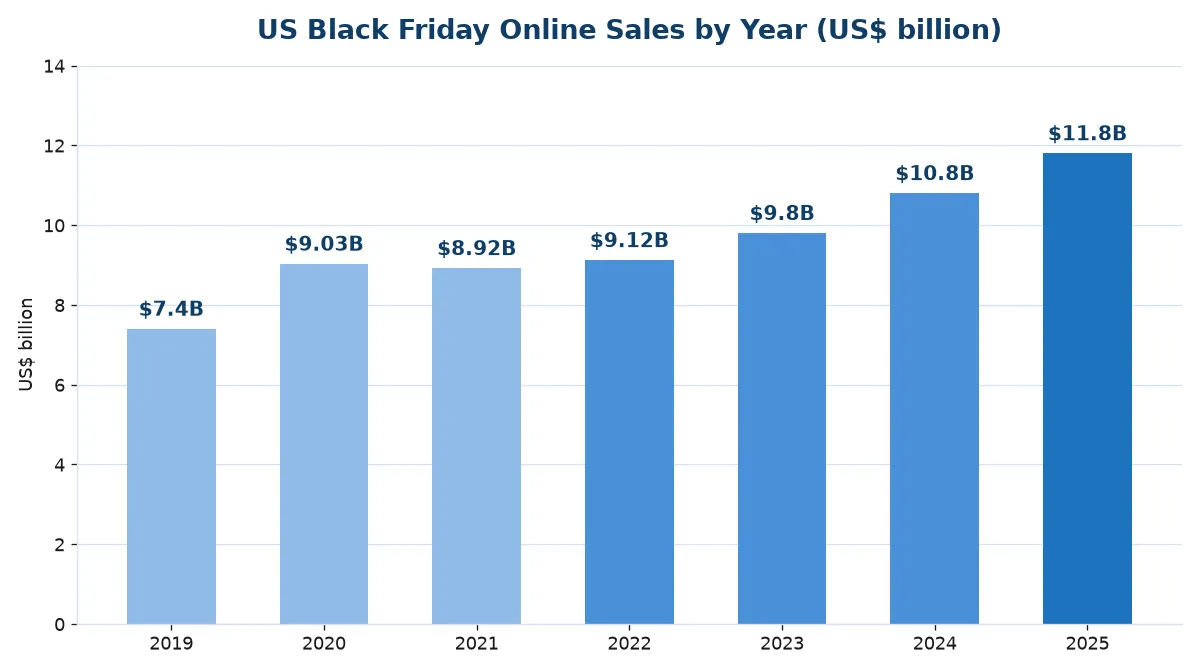
| Year | US Black Friday online sales |
|---|---|
| 2025 | $11.8 billion |
| 2024 | $10.8 billion |
| 2023 | $9.8 billion |
| 2022 | $9.12 billion |
| 2021 | $8.92 billion |
What this means: Black Friday statistics on sales show steady growth, so online stores should plan for a bigger day every year.
How much is spent on Black Friday worldwide?
Shoppers around the world spent $79 billion online on Black Friday last year, up 6%.
The US share of that total was $18 billion. Across the full Cyber Week, global online sales reached a record $336.6 billion, up 7%. Europe grew fastest at 12%. In the US, Black Friday statistics for all retail show sales up 4.1%, with online up 10.4% and stores up just 1.7%.
| Global measure | Online sales last year |
|---|---|
| Global Cyber Week | $336.6 billion |
| Global Black Friday | $79 billion |
| Global Cyber Monday | $53 billion |
| US Black Friday | $18 billion |
What this means: Black Friday statistics now describe a worldwide event, not just a US shopping day.
How many people shop on Black Friday?
A record 202.9 million Americans shopped from Thanksgiving to Cyber Monday last year.
Online shoppers rose 9% to 134.9 million, and in-store shoppers rose 3% to 129.5 million. Black Friday was the top day in both channels, with 85.7 million online and 80.3 million in stores.
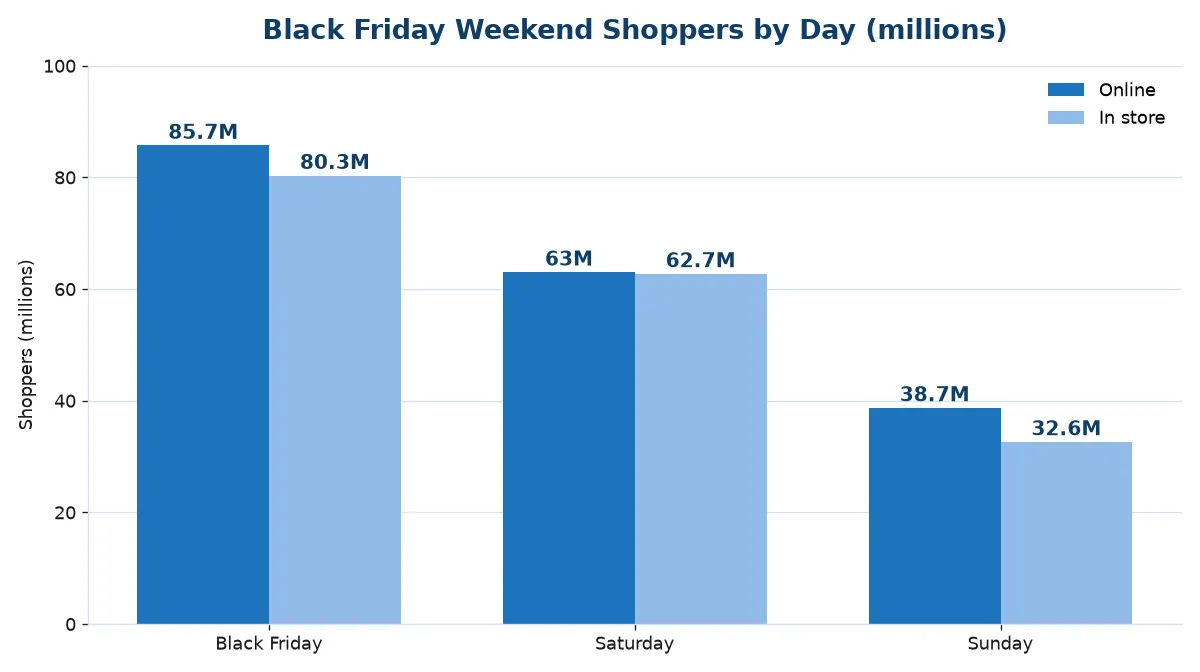
| Day | Online shoppers | In-store shoppers |
|---|---|---|
| Black Friday | 85.7 million | 80.3 million |
| Saturday | 63.0 million | 62.7 million |
| Sunday | 38.7 million | 32.6 million |
What this means: Black Friday statistics on shoppers show a five day event, so deals should run the whole weekend.
How big are Cyber Week and Cyber Monday?
US Cyber Week online sales reached $44.2 billion last year, up 7.7%.
Cyber Monday was still the biggest online day of the year at $14.25 billion, up 7.1%. Black Friday statistics show the Friday growing faster, though, for the second year in a row.
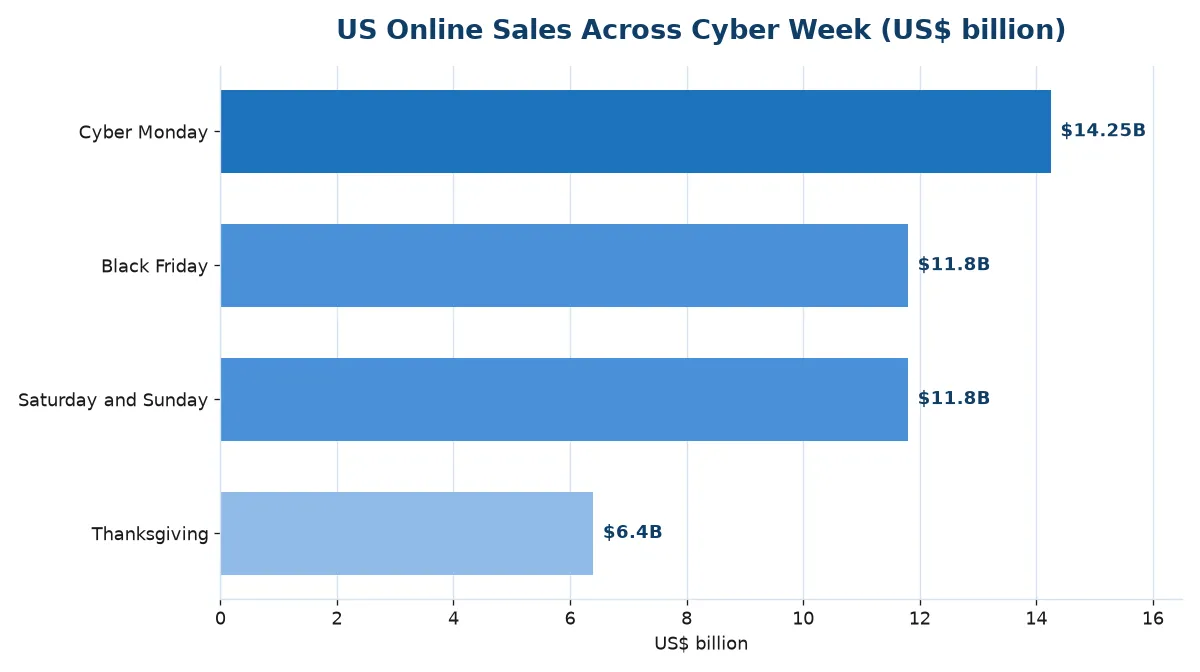
| Cyber Week day | US online sales |
|---|---|
| Cyber Monday | $14.25 billion |
| Black Friday | $11.8 billion |
| Saturday and Sunday | $11.8 billion |
| Thanksgiving | $6.4 billion |
What this means: Black Friday statistics show the money spread across five days, with Cyber Monday still on top.
How much of Black Friday shopping happens on mobile?
Mobile devices drove 55.2% of US Black Friday online sales, or $6.5 billion.
Mobile sales grew 10.2%, faster than total online sales. Phones took an even bigger share on Thanksgiving, at 61.6%, and on Cyber Monday, at 57.5%. Around the world, phones placed 70% of online orders during Cyber Week. Brands that want to reach phone shoppers by text can check our Omnisend email and SMS marketing review.
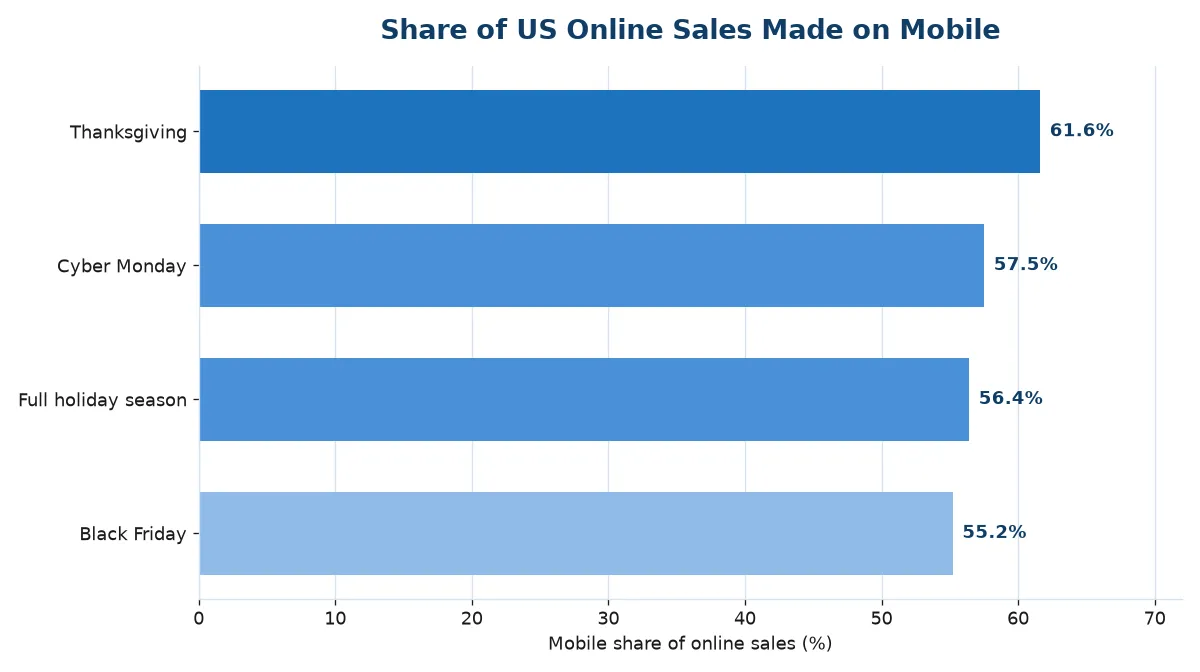
| Shopping day | Mobile share of US online sales |
|---|---|
| Thanksgiving | 61.6% |
| Cyber Monday | 57.5% |
| Full holiday season | 56.4% |
| Black Friday | 55.2% |
What this means: Black Friday statistics on mobile show that a slow phone checkout now costs more than half your sales.
How much does the average shopper spend on Black Friday?
Shoppers plan to spend $624 each across Black Friday and Cyber Monday this year, about the same as last year.
Black Friday statistics show Gen Z planning to spend the most, at $752 each. About half of shoppers will also buy a gift for themselves, spending $208 on average. Independent online brands saw an average cart of $114.70 over the weekend last year. Shoppers plan to put 61% of their budget online and 39% in stores.
| Spending measure | Average amount |
|---|---|
| Gen Z planned spend | $752 |
| All shoppers planned spend | $624 |
| Gift for yourself | $208 |
| Average online cart at independent brands | $114.70 |
What this means: Black Friday statistics on spending show budgets holding flat, so sellers must win a bigger share of the same wallet.
What are the top Black Friday categories?
Game console sales jumped 1,900% on Black Friday compared with a normal day.
TVs rose 1,740%, and headphones and speakers rose 1,700%. In these Black Friday statistics, fridges and freezers rose 1,630%. Affiliates in style niches can find good offers in our best fashion affiliate programs list.
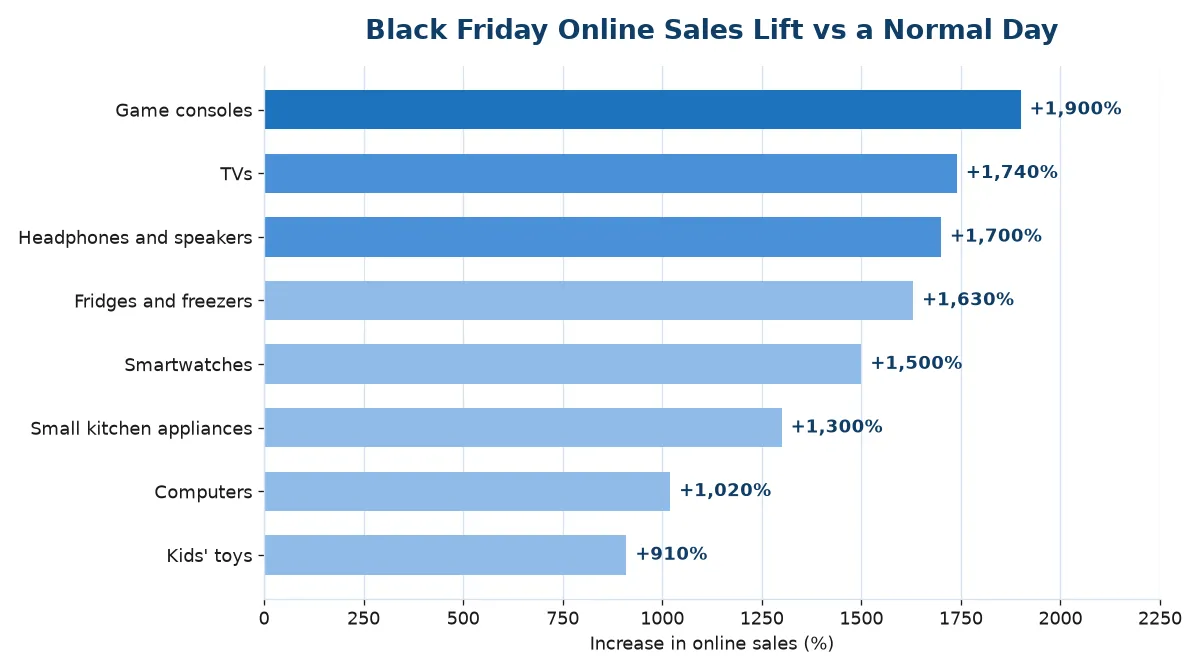
| Category | Online sales lift vs a normal day |
|---|---|
| Game consoles | 1,900% |
| TVs | 1,740% |
| Headphones and speakers | 1,700% |
| Fridges and freezers | 1,630% |
| Computers | 1,020% |
| Kids’ toys | 910% |
What this means: Black Friday statistics on categories show tech and big home items gain the most from the day.
Who shops on Black Friday the most?
94% of Gen Z shoppers plan to shop Black Friday and Cyber Monday this year, more than any other age group.
Gen Z is also expected to make up about 21% of all spending for the week. In stores, 72% of Gen Z shoppers plan to visit on Black Friday, compared with 53% of all shoppers. Older shoppers are cooling off. Only 39% of Gen X and Boomers planned to shop the big sales last year, versus 58% of younger adults.
| Gen Z and all shoppers | Share this year |
|---|---|
| Gen Z planning to shop the week | 94% |
| All adults planning to shop the week | 87% |
| Gen Z planning to shop in stores on Black Friday | 72% |
| All shoppers planning to shop in stores on Black Friday | 53% |
What this means: Black Friday statistics on age show younger shoppers now drive the event, both online and in stores.
How big are Black Friday discounts?
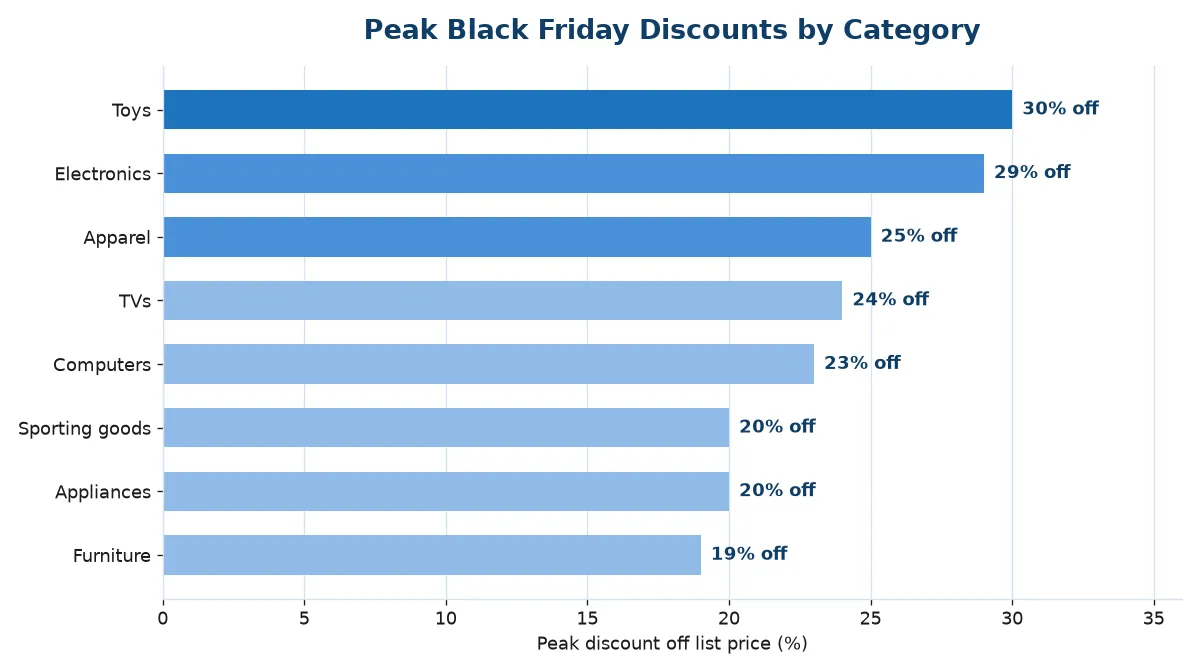
Toys had the deepest Black Friday discounts last year, at up to 30% off the list price.
Electronics followed at 29% off, apparel at 25% and TVs at 24%. Black Friday statistics also show deals pushing people to trade up, with the share of top priced electronics sold up 64%. Software buyers can also find year round lifetime deals in our AppSumo software deals review.
| Category | Peak Black Friday discount |
|---|---|
| Toys | 30% |
| Electronics | 29% |
| Apparel | 25% |
| TVs | 24% |
| Computers | 23% |
| Appliances | 20% |
What this means: Black Friday statistics on discounts show shoppers use deals to buy better products, not just cheaper ones.
How much do shoppers use buy now, pay later on Black Friday?
Buy now, pay later covered $747.5 million of US Black Friday online sales last year, up 8.9%.
In Black Friday statistics, that is 6.3% of online sales, and 80.7% of it came from phones. Cyber Monday became the first day to pass $1 billion in pay later spending, at $1.03 billion. Across the full holiday season, pay later spending reached $20 billion.
| Buy now, pay later measure | Online spending last year |
|---|---|
| Full holiday season | $20 billion |
| Cyber Monday | $1.03 billion |
| Black Friday | $747.5 million |
What this means: Black Friday statistics on payments show flexible checkout options help close bigger orders.
How are AI and chatbots changing Black Friday shopping?
Traffic to US retail sites from AI tools jumped 805% on Black Friday last year.
Black Friday statistics show AI visitors were 38% more likely to buy than other visitors. Around the world, AI and shopping agents shaped 20% of Cyber Week orders, worth about $67 billion. Affiliate marketers can also share in this traffic, since affiliates and partners drove 21.9% of Black Friday revenue. New publishers can start with our best affiliate programs for beginners.
| AI shopping measure | Latest figure |
|---|---|
| AI traffic growth on Black Friday | 805% |
| Shoppers planning to use AI | 59% |
| Higher chance to buy from AI visits | 38% |
| Global Cyber Week orders shaped by AI | 20% |
What this means: Black Friday statistics on AI show product pages must be clear enough for chat tools to read and recommend.
Which countries embrace Black Friday the most?
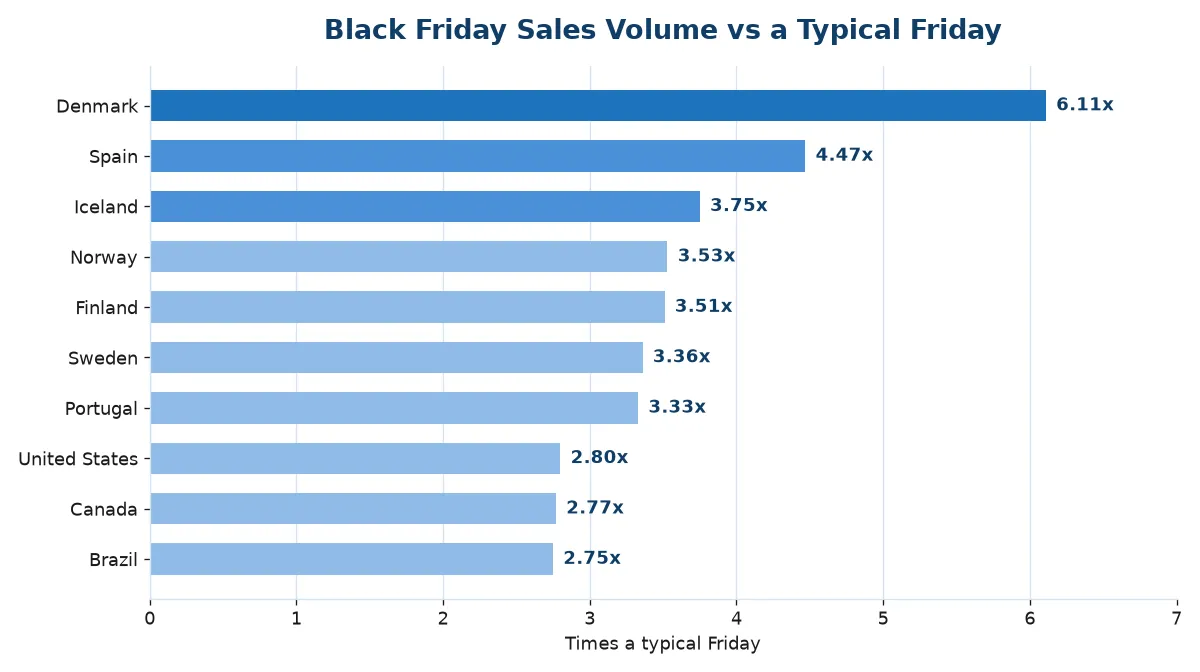
Denmark sees the biggest Black Friday jump, with sales volume 6.11 times a typical Friday.
Spain comes next at 4.47 times. In these Black Friday statistics, the US ranks eighth at 2.80 times. UK shoppers spent $5 billion online from Black Friday to Cyber Monday, up 4.6%.
| Country | Black Friday sales vs a typical Friday |
|---|---|
| Denmark | 6.11x |
| Spain | 4.47x |
| Iceland | 3.75x |
| Norway | 3.53x |
| Finland | 3.51x |
| Sweden | 3.36x |
| Portugal | 3.33x |
| United States | 2.80x |
| Canada | 2.77x |
| Brazil | 2.75x |
What this means: Black Friday statistics by country show that Europe now leans on the day even harder than the US.
What challenges does Black Friday face?
36% of Americans said last year that they are less interested in Black Friday than a few years ago.
Of those, 63% blame misleading discounts. The online refund rate for Black Friday orders hit 11.32%, against 8.33% across a normal year. The number of people planning to shop the long weekend also dipped to 182.7 million this year, from 186.9 million.
| Challenge measure | Latest figure |
|---|---|
| Less interested who blame fake deals | 63% |
| Americans less interested in the event | 36% |
| Refund rate on Black Friday orders | 11.32% |
| Refund rate on a normal day | 8.33% |
What this means: Black Friday statistics on trust show that honest, clear pricing now matters as much as the size of the discount.
What is the Black Friday forecast for 2026?
US online Black Friday sales are expected to reach $12.9 billion this year, up 9.2%.
Black Friday statistics also point to Cyber Monday passing $15 billion for the first time. Cyber Week should bring in $47.5 billion online. Pay later spending on Black Friday is expected to hit $807 million, and total US holiday retail sales should top $1 trillion.
| Forecast measure | Expected this year |
|---|---|
| US holiday retail sales | $1.013 trillion |
| Cyber Week online sales | $47.5 billion |
| Cyber Monday online sales | $15.1 billion |
| Black Friday online sales | $12.9 billion |
What this means: Black Friday statistics for 2026 point to another record, with growth led by phones, AI and early deals.
Did you know? Many shoppers now ask chat tools for deals before they buy. See how fast that habit is growing in our AI chatbot statistics roundup.
Pros
- US online Black Friday sales hit a record $11.8 billion
- Global online sales reached $79 billion
- A record 202.9 million Americans shopped the long weekend
- Discounts reached up to 30% off in key categories
- Mobile drove more than half of online sales
- AI shopping traffic grew 805% in a single year
Cons
- In-store sales grew only 1.7%
- 36% of Americans say they are less interested in the event
- Online refund rates jump to 11.32% for Black Friday orders
Black Friday statistics for 2026 show an event that keeps setting records online. Slow store growth and weaker trust are real limits, but no other shopping day matches its scale.
Quick Links
- YouTube Statistics 2026: Usage, Market Size and Trends
- AI Chatbot Statistics 2026: Usage, Market Size and Trends
- Fortnite Statistics 2026: Usage, Market Size and Trends
- GTA 6 Statistics 2026: Sales, Records and Launch Numbers
Black Friday Statistics FAQs
How much was spent on Black Friday last year?
US shoppers spent a record $11.8 billion online on Black Friday last year, up 9.1% from $10.8 billion the year before. Around the world, online Black Friday sales reached $79 billion. These Black Friday statistics make it the fourth record year in a row.
How many people shop on Black Friday?
About 85.7 million Americans shopped online on Black Friday last year, and 80.3 million shopped in stores. Across the five days from Thanksgiving to Cyber Monday, a record 202.9 million people shopped., 126 million people plan to shop on Black Friday itself.
Is Black Friday or Cyber Monday bigger?
Cyber Monday is bigger for online sales. It brought in $14.25 billion last year, compared with $11.8 billion on Black Friday. Black Friday is growing faster, though, and it is still the top day for store visits and total shoppers. This year, Cyber Monday is expected to pass $15 billion for the first time.
What percentage of Black Friday sales are on mobile?
Mobile devices drove 55.2% of US online Black Friday sales last year, worth $6.5 billion. Phones took an even bigger share on Thanksgiving, at 61.6%. Around the world, phones place about 70% of all online orders during Cyber Week. Five years ago, mobile drove only 41.4% of Cyber Monday sales.
How much does the average person spend on Black Friday?
Shoppers plan to spend about $624 each across Black Friday and Cyber Monday this year, about the same as last year. Gen Z plans to spend the most, at $752. Half of shoppers also plan to buy something for themselves, spending $208 on average. Independent online brands saw an average cart of $114.70.
What sells the most on Black Friday?
Tech and home items see the biggest jumps. Game console sales rose 1,900% on Black Friday compared with a normal day, TVs rose 1,740% and headphones rose 1,700%. Clothing is still the most planned gift, with 76% of shoppers planning to buy it.
Are Black Friday deals really worth it?
Often, yes. Discounts last year reached 30% off on toys, 29% on electronics and 25% on apparel. Many shoppers used deals to trade up to better products. Still, 63% of people who have lost interest in the event blame misleading discounts, so it pays to track prices before the sale starts.
How much is spent with buy now, pay later on Black Friday?
Buy now, pay later covered $747.5 million of US Black Friday online sales last year, up 8.9%. Cyber Monday was the first day to pass $1 billion in pay later spending. This year, Black Friday pay later spending is expected to reach $807 million.
Which country celebrates Black Friday the most?
The US created Black Friday, but Denmark sees the biggest jump in sales. Its Black Friday volume is 6.11 times a typical Friday. Spain is next at 4.47 times, while the US ranks eighth at 2.80 times. UK shoppers spent $5 billion online from Black Friday to Cyber Monday last year.
Conclusion: Black Friday Statistics 2026 in Numbers
Black Friday statistics for 2026 show an event that is still growing. US shoppers spent a record $11.8 billion online on Black Friday last year, the world spent $79 billion, and 202.9 million Americans shopped the long weekend. Phones drove more than half of online sales, and AI traffic grew 805%. With early deals, pay later options and AI tools all rising, this year looks set for another record.